It’s another holiday season, so please permit me to wish you all the very best…customers, family and friends!
Peace!
~TRW
It’s another holiday season, so please permit me to wish you all the very best…customers, family and friends!
Peace!
~TRW
On many of my earlier blog posts, I’ve talked about the importance of video for any business, service or non-profit. Video continues to grow in importance and as represented by the second frame of the following infographic, by next year, EIGHTY PERCENT of online content will be video! If you’re not doing video, you are missing opportunities on an unimaginable level, if you’re doing videos and want to tap into a professional with decades in the genre, give me a call.

With thanks to WebpageFX for the creation of a terrific infographic!
Got video?
How much is a college scholarship worth to your family? If you’re reading this article, you’re probably thinking about that question. A highlight video may be the essential vehicle to secure an athletic scholarship, and for many, this may be the only way an athlete could ever aspire to attend college.
Coaches, scouts and recruiters don’t have the time or budget to visit with every potential recruit, so why not take the recruit to them – through a professionally produced highlight video. Coaches want to see the athlete’s skill, hear his or her speaking abilities, and observe his or her work ethic in the gym or practice field. One key factor is how to bundle those highlights to make the athlete stand out from all the others vying for scholarships. But the best packages require cost considerations that are—far too often—overlooked or ignored. This is NOT about whipping out your smartphone and shooting away…there is purpose and process to the capture of a compelling sports video.
# # # # # # # # #
I get several requests a year from parents looking for video for their aspiring young athletes. I shoot high-school sports for Fox Sports PrepZone, plus I played a game or two in my youth, so I have a bit of an understanding how to do it. That being said, when it comes to capturing the kind of video that would make a compelling “recruiting reel,” there are several things to consider.
Let’s start with equipment. You need good quality cameras capable of adjusting to wide ranges of light (from very bright sunlight, to dark, with the field illuminated). All the major camera manufacturers have gear that will get the job done. Personally, I favor Sony. Audio capture should be a shotgun mic capable of picking up the field announcer.
Next, you need access to the field. This may require permission from the home school’s athletic director, who will also authorize credentials for the stands (and sidelines, if that’s part of the arrangement). Also, check with the AD to see if releases are required. And don’t even think about showing up for a professional (paid) assignment without business insurance. If a parent trips over a tripod or cable and falls, and you’re NOT insured…..well, you just don’t even want to go there!!
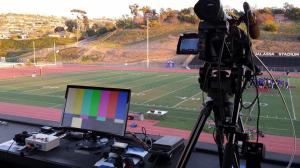
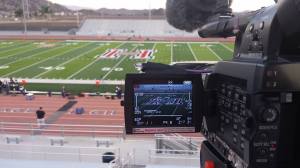
So you’ve made it into the stadium! Now you need a vantage point. Depending on the arrangement, you will want to be as high as possible to capture the action. Back to equipment, the camera must have a good zoom range to be able to move in on the action as the play develops—and keep in focus! You need to get to the stadium early…repeat, EARLY, to get that spot. Parents, family and boosters will be there, and they have NO obligation to give you space to shoot. If you’re lucky enough to get in or on top of the press box, consider yourself fortunate…that’s usually where you’ll find me, with my Fox Sports camera!
High school football games typically last 2 – 3 hours, plus halftime, plus the aforementioned early arrival, and strike (tear down) time. So, the total time on property can be 5 to 7 hours. And then, there’s post-production. This entails reviewing ALL the game footage, looking for those “gems” to go into the finished product. Then time has to be allotted for editing, including game “isolations” (called “ISOS”), graphics, personal statistics and any other desired elements.
# # # # # # # # #
So, taking all of this into consideration, what does a recruiting video cost? Prices, complete with stats panels, isolations of the athlete, slow-motion “snippets” of plays and contact information can range from $500 to $1,500 and higher, often per game. There are several national companies that do this and some use networks of videographers to capture the video footage, with post production done at a headquarters location.
These videos, done at the professional level, aren’t cheap. But go back to the first question in this essay and ask it again. A four-year scholarship to UCLA, Alabama, or Ohio State could save a family a six-figure investment, so even at the high end for a recruiting video, that’s a pretty solid return on investment!
I would be happy to speak with you regarding your sports video needs and the initial consultation is free. Call or email me for more information!

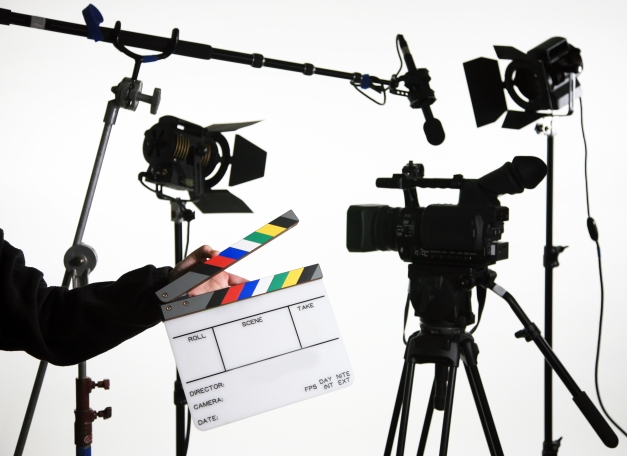
Finding a great video setting is one of the most important parts of the video production process. There are a lot of different elements that go into finding just the right spot.
As you prepare to produce a video, one of the details that probably should not be left until the end is the actual shoot location. Where should you shoot your video? Indoors? Outdoors? Conference rooms? Or rooms with a view? There are several things to you should be sure to consider before making this decision and choosing an interview location for your video shoot.
Get permission first
Before thinking about the creative approach to your interview location, make sure you have permission to shoot there! If you’re hoping to shoot in a public place, you should check with your local government to get a permit. If you’re shooting in an office or the courtyard of your attractive local shopping plaza, you’ll need a release from the owner(s) of the property. Nothing will be more embarrassing than getting set up at a location, only to be chased away by security—or the police—because you didn’t get the go-ahead in advance. Many municipalities and companies in Orange County have gotten very strict about this.
Be careful about distractions
When choosing a location, it’s important that your viewers stay engaged with your video content. Lots of distracting visuals or people moving in and out of your shot can draw the attention away from your primary message. And watch out for those camera-hungry photobombers!
Consider being flexible with your shoot time. Think about scheduling, if in a space such as a manufacturing area, when machines can be powered down, and there may not be as many people talking or moving in the background. Unless, of course, you want a busy, noisy background. Sometimes this is the look/sound you’re going for!
Make it relevant
What background do you want behind your interview subject? Make sure it’s relevant to the style and subject matter of your video. Choosing an appropriate background can really transport viewers to your location and help them connect the dots with what the user is saying. But remember, you can also use supporting visuals (B-roll) to showcase more specifics about the style and culture of your company.
Find a spacious location

Choose a big location with some architectural features for added texture. More spacious locations allow for setting up the shot with a shallower depth of field, giving your video that blurred background effect and minimizing background details and focusing more clearly on your subject, putting the viewer’s attention on their face.
Don’t forget that you are looking for a location that can fit more than just your interview subject. You’ll also need room for your video production team and any equipment as well. While you don’t want an airplane hangar, it’s important to make sure you have enough room for everyone—and everything—involved!
Conference Rooms
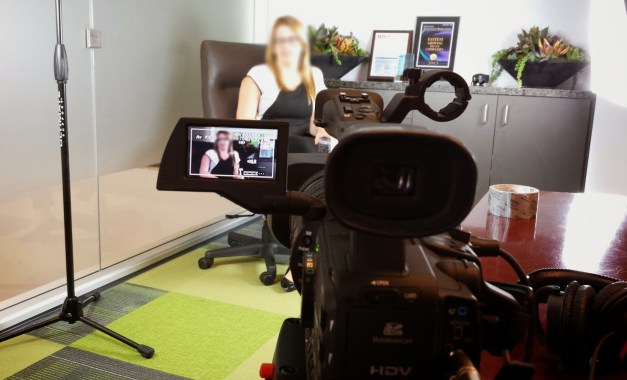
They may be quiet and available, but there is nothing more boring than a flat wall behind your interview subject. Full disclosure: I use them frequently and if that’s my working space for the project, I shoot at an angle against the wall and try splashing some color in the background by adding a plant or art piece, etc. Another tactic is to get as much distance as possible between the subject and the wall so the background can be blurred.
A “heads up” about conference rooms: In many cases they have big conference tables that can be difficult to move. This can limit options when trying to create an interesting or unique look.
Watch the weather
It’s not always best to shoot on a sunny day, despite how tempting it may be. Typically, bright days can mean harsh shadows on the faces of interview subjects. Unless you’re going to blast your subject with expensive lights, or use reflector kits, you may want to avoid shooting on those picture-perfect days. Believe it or not, an overcast day is typically a better day to shoot video outdoors.
Listen for room tone and ambient noise
Once you have found a location that is free from distractions, take a moment to carefully listen. Pay attention to the room tone and ambient noise. It’s important to avoid shooting in overly noisy areas, unless the background sound fits the message of the piece. In other words, if you’re shooting a piece on manufacturing, you probably won’t mind hearing the natural sound from that environment in the story.
However, if your space has a buzz, hum, or echo, the microphone will pick it up also. There are a few remedies to a loud room tone: First, identify the source of the hum. If the hum comes from a refrigerator, air conditioner, or another device that can be turned off temporarily, do that. If not, pro’s tackle these issues by using directional microphones, recording room tone for post-production, or using equalizers, but all those require a level of expertise.
Consider the lighting
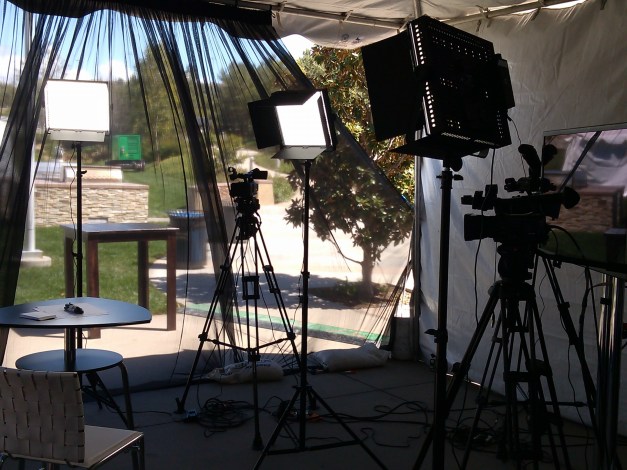
What many people may not realize is the strength of sunlight that you see out windows can overpower the light used on the face of an interview subject. Your video production team can help you get great front lighting, but it’s not always possible to make the subject look great AND see scenery out a window. In addition to lighting challenges, many people overlook the fact that wonderful views usually look better while standing at the window peering out than they do as a background for an interview. In many cases, what is actually seen is the sky or some buildings in the distance.
If you are planning an outdoor shoot, try to shoot dawn and dusk, especially in the summer months. The light is more mellow which creates less harsh shadows, plus it can be much more dramatic! If you can, consider a “Golden Hour” timeframe for your shoot. Golden hour is the hour after sunrise or before sunset where the sunlight is more golden and soft and makes memorable and dramatic lighting for video shoots.
Remember, preparation is KEY
You can never be too prepared. If you do all the hard work before the shoot, you can focus on your subjects on production day. Selecting the proper locations for your shoot can make a huge difference in the final product, so give a call and ask about doing a site check — even if it means spending a little money, you’ll be glad you did!
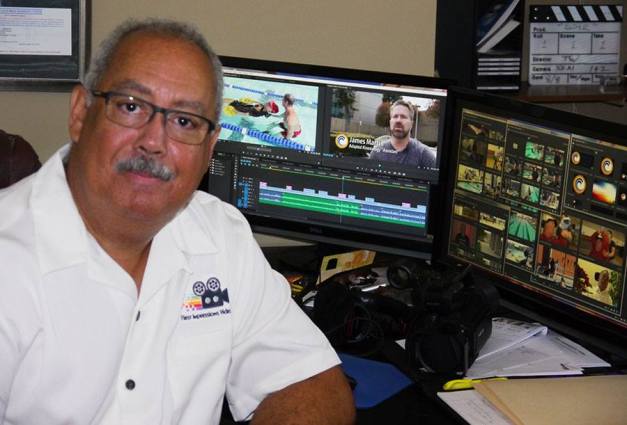
2017 was the celebration of the 5th anniversary of First Impressions Video, as a full-time venture. Each year was more gratifying than the one it followed and 2018 is already looking to be the best yet! There are many to thank for this prosperity as it is my wonderful clients that made it happen! And in no particular order, shout-outs and sincere thanks to the following:
And as we begin 2018, there are several trends worth noting, for those thinking about video in your business plans.
There are so many trends to address that it would take three times the size of this blog to share them all, but it’s December 22nd and I’ve got things to do before Christmas! Plus, I’ll be in my normal place behind Camera 1 at Mariners Church for the Christmas services! Perhaps I’ll see you there, but in the event I don’t, please allow me to wish you and yours the most wonderful Christmas and Holiday season, and a very prosperous 2018!
~TRW

Wishing everyone the happiest of holidays and a prosperous 2018!

I’ve shot a lot of weddings since starting First Impressions Video. They are gratifying, for sure, but a challenge because of the emotion associated with them–and the desire to get it right. As it is in most event videography, there are no “second takes.” Between bride and groom prep, through the ceremony and reception, there are many aspects to capture and as a result, several places where things can go sideways–especially during the ceremony.
The still photographer has a pivotal role in a wedding and I’ve worked with many outstanding ones. A crucial element that constitutes an “outstanding” photographer is an inherent sense to “share the space” with videographers. This is extremely vital as both photographer and videographer have key “money shots” that are essential components of the photographer’s album and the videographer’s DVD (or other delivery medium). In a wedding I recently recorded for a very special family, I found myself working with one of the most difficult and selfish photographers I’ve ever encountered. Not only that, he brought his son as a 2nd camera, and together, they seemed to go out of their way to crowd me out of all the aforementioned “money shots.” I was able to get them, despite their obliviousness to my presence, as if I wasn’t entitled to the same space they occupied. As we reached the “I now pronounce you” moment, I actually had to physically move one of them so that I could capture “you may now kiss your bride!” The guy seemed stunned that I pulled him out of the way and I can assure you that as a 240-pound former Marine, I was no longer in the mood for these antics, as this had gone on throughout the ceremony.
This behavior wasn’t missed by the family who were equally displeased, and said so to me. The disappointing part is that I go out of my way to befriend not only the photographers assigned to a wedding, but all of the vendors. I’m also pleased to say, that this is a rare occurrence. We all have important jobs to do to make the day super special for the bride and groom, and their families and friends. In order for that to happen and for us to do our jobs in ways that exceed expectations, we have to…wait for it…share the space!

It’s been said before, but bears repeating: Every video should tell a story! Even 15 second commercials do this, so it stands to reason that anything longer should be a no-brainer, but it often isn’t.
So, let me point out that the nucleus of any story should have three main points:
Yeah, I know it’s simplistic, but this is the cornerstone of any story “arc.” Having spent 30 years in marketing, there is another way to look at it:
If you do this right, there’s one last three-point metaphor:
Any questions?
Note: for those interested in delving into the full complexity of story development, there are hundreds of books, blogs and videos that will expand your horizons. I just wanted to keep it short and simple today…lots of projects in the workflow !
~TRW

Yesterday was August 1st. On that day in 1981, Music Television, or MTV, was launched. It was a somewhat shaky start with cable television still trying to catch traction. Fast forward to today and there are hundreds of cable outlets, with dozens of other streaming and online options for viewing content. But along with music videos, MTV also launched something else: the creation of the “logo bug” that now appears (usually) in the lower right corner of most of the programming we see today! Even video producers like this writer “bug” their videos, which I chronicled in a post back in 2015! http://wp.me/p2YaU5-8Y
If you want to place a lasting impression on your productions, be sure to “bug” them! Thanks, MTV, for an iconic idea!
If you’ve read my blog, you know how important I believe video is as part of any business’ marketing mix. Video continues to command greater percentages of marketers’ collective attention and this trend will not slow down for the foreseeable future, as noted below. Sources for each—when provided—are captioned in parentheses.
Moral of the story
The biggest roadblock for marketers to add video marketing is getting started. This is particularly relevant for small business owners. Granted, many have made the move, but just as many have not. It doesn’t take thousands of dollars to produce a video anymore—even when using a professional, so don’t be dissuaded into reaching for a smartphone, with all its inherent shortcomings. Are there times when this might be a good option? Most certainly! If it’s a once-in-a-lifetime live event, go for it! But with that said, if you’re telling the story of your business, you will be much better served with pro level cameras, microphones and lighting.
So, if you want to get started, why not give me a call? Consultations are free and even if you don’t select First Impressions Video to do the work, you’ll have a much better understanding of the task, coupled with expectations that will match the finished product.


Proud to be a member of this prestigious organization

 First Impressions Video